


The State of Kotlin in 2026
15 years of growth, trust, ecosystem maturity, and an estimated 8.1M developers worldwide.
Is Kotlin here to stay?
15 years of growth, ecosystem investment, and organizational adoption.
See the evidence →Can we adopt Kotlin without a disruptive rewrite?
Backend adoption, Java interoperability, and modernization paths.
See how teams adopt Kotlin →Can Kotlin scale across platforms?
Kotlin Multiplatform adoption, production use, and reported business outcomes.
See the KMP findings →How does Kotlin fit into the AI era?
AI-assisted development, public benchmark results, and AI systems built with Kotlin.
See the Kotlin + AI findings →Kotlin: 15 years in numbers

8M+
Kotlin developers worldwide

50%+
use Kotlin for backend tasks

30%+
use Kotlin on multiplatform projects

80%
use Kotlin in real production environments.

81%
say AI-generated Kotlin code is correct or needs minor fixes

87%
are satisfied or very satisfied with the language
15 years of steady growth
Fifteen years in, Kotlin is still growing – and the developers who join tend to stay. Independent rankings show the same curve.
GitHub Octoverse 2024
Top-5 fastest-growing languagesStack Overflow 2024
Among the most admired languages
Kotlin across organizations of every size
Kotlin is used by organizations of every size – from independent developers to large enterprises – and across a broad range of software-intensive industries. Its widespread use in production further reflects growing organizational confidence in the language.
From solo developers to global enterprises
From independent developers to enterprises with 5,000+ employees
- Around one quarter of Kotlin developers work in large organizations (500+ employees)
- Adoption spans startups, growing companies, and global enterprises
Kotlin developers by organization size
Kotlin adoption spans organizations of all sizes, from independent developers to large enterprises.
Run in production across industries
Production usage is a strong indicator of organizational confidence in Kotlin.
Explore Kotlin for Business80%
of Kotlin developers
use Kotlin in production code
- Software development
- Cloud
- Fintech
- Healthcare
- Education
- Media
- Consumer services

Eliminated null-related crashes to zero

Sped up feature delivery

Increased developer productivity

Ensured payment accuracy

Scaled their AI platform to 1M+ users

Sped up shipping with shared code

Reduced crashes and improved performance

Started shipping features simultaneously on iOS and Android

Built features cross-platform without expanding their team

Streamlined collaboration between their Android and iOS teams

Cut feature delivery cycles from 2 months to 1


Backend: Production-proven on the JVM
Backend is one of Kotlin's largest domains – over half of Kotlin developers work on backend projects. Kotlin compiles to the same bytecode as Java and calls existing Java code directly, so it enters organizations service by service, without big rewrites.
The larger the organization, the more likely Kotlin is already there
Share of organizations with any Kotlin on the backend, by number of backend developers:
*Anonymized JetBrains IDE data; commercial organizations doing backend development. An organization counts as using Kotlin if at least one of its backend developers works with Kotlin.
A measurable productivity payoff
15–20%
Kotlin adoption happens at modernization moments
Java teams revisit the language question when they’re already reworking the codebase
8× higher
Kotlin adoption among projects that migrated Spring Boot 2→3, compared with teams that stayed put
70%
of new Kotlin backend adopters already had Spring in their project
Now
the ecosystem is moving to Spring Boot 4, and a major migration is exactly when teams add Kotlin
Committed for the long run
A backend language is a decade-long choice – and the ecosystem behind Kotlin treats it that way:
Runs on your frameworks
61%
of Kotlin backend developers use Spring / Spring Boot
51%
of Kotlin backend developers use Ktor
Backend Kotlin in production
Amazon
Migrated a 10,000-line backend service from Java to Kotlin – powering an AI-driven size recommendation system for hundreds of millions of customers across 19 locales.

Wolt
Kotlin is a core part of Wolt's backend systems and engineering culture, powering their delivery platform.
ING
Modernized its mission-critical payment engine – 6M mobile users, 4.5B payments a year – migrating from Java to Kotlin for code quality, stability, and resource efficiency.

Kotlin Multiplatform: From experiment to strategic platform
Kotlin Multiplatform has evolved from an experimental technology into a production-ready platform for cross-platform development. Organizations use it to share business logic and user interfaces across Android, iOS, desktop, web, and server, while preserving native flexibility.
Production-ready and backed for the long run
Stable since 2023
Google officially endorses KMP for sharing business logic between Android and iOS
Compose Multiplatform for iOS Stable since 2025
4,000+ community libraries
The fastest-growing cross-platform technology
KMP's share among cross-platform developers more than doubled in one year, from 7% (2024) to 18% (2025)
KMP’s footprint in the App Store top 10,000 nearly tripled since early 2024, and over the past year KMP added more top-10,000 apps than Flutter did.
According to our KMP case studies, hundreds of millions of users interact with KMP-powered apps daily
Business impact
60%
of KMP projects share all or almost all of their business logic
72%
of teams report faster development, 70% higher app quality, and 55% better collaboration between Android and iOS teams.
Native UX
Adopters report shipping features faster without giving up native UX
Kotlin Multiplatform in production

Booking.com
“Adopting KMP for our experimentation library was a calculated bet. […] The reality exceeded our expectations: KMP performed great on iOS, proving it's a viable, long-term solution for our team.”
Principal Android Developer
Duolingo
“The more that we use Kotlin Multiplatform internally, the more we find ourselves speeding up in terms of shipping.”
The Client Platform team

Sony
“Sony's journey to Kotlin Multiplatform wasn't just about efficiency; it was about capability. We migrated from native plans to a unified KMP and Compose Multiplatform workflow, delivering a robust companion app for our flagship headphones […] to millions of users worldwide.”
TechLead at Sony


Kotlin and AI: Tested in real workflows.
The qualities that make Kotlin strong in production – static typing, null safety, and coroutines – pay off twice in the AI era. They make AI services easier to build and AI-generated code easier to trust. The data below covers both directions.
AI-assisted Kotlin development
AI tools are already common in the surveyed group, and the output holds up.
93%
use at least one AI coding tool
81%
say AI-generated Kotlin is usually correct or needs only minor fixes
Verified by developers
Only 0.3% ship AI-written code without any validation. Practically everyone reviews, runs, or tests the result. Kotlin makes that check easier: When AI invents a method or misuses a nullable value, the code fails to compile before review even starts.
How developers validate AI-generated Kotlin code
Source: JetBrains State of Kotlin and AI Survey 2026. The shares in this multi-selection question do not total 100%.
“Kotlin's strict compiler and clear build-time errors give it an edge. The AI can easily understand and fix compilation errors before running the code. I'm comparing it to runtime languages like Python or JavaScript, where tracking down bugs is more complex because they only surface during execution.”
Adeeb, Android Developer
“Short term, popular GitHub languages like Python and JS/TS are huge because of the training data. Long term, highly structured languages with strong and meaningful references are going to win because they reduce error. […]”
Steve, Engineering Lead
“Strong type system, brief and expressive language (less token to generate/read, easier to review).”
Lucas, Engineering Lead
Measured in the open: the Kotlin Benchmark
The Kotlin Benchmark runs AI coding agents on real issues from active open-source Kotlin repositories, giving teams a public way to measure agent performance and compare setups. In the first public run, the top agent setup resolved 90 of 105 real Kotlin engineering tasks end to end.
86%
of real Kotlin tasks resolved by the top agent
The Kotlin Benchmark Leaderboard
| # | Setup (Agent + LLM) | Submitted | Resolved | Resolution Rate | Avg. Tokens (M) | Avg. Latency | Date |
|---|---|---|---|---|---|---|---|
| 1 | Claude Code + Opus 4.7 xhigh | 105 | 90 | 85.71% | 10.59 | 10h 37m | 06.05.2026 |
| 2 | Junie + Opus 4.7 max | 105 | 86 | 81.90% | 19.98 | 19h 58m | 23.04.2026 |
| 3 | Codex + GPT 5.5 xHigh | 105 | 86 | 81.90% | 38.78 | 8h 30m | 26.04.2026 |
| 4 | Claude Code + Opus 4.6 max | 105 | 84 | 80.00% | 13.93 | 12h 39m | 19.03.2026 |
| 5 | Codex + GPT 5.3 Codex xHigh | 105 | 82 | 78.10% | 8.56 | 8h 1m | 19.03.2026 |
Leaderboard snapshot as of July 8. For the latest results, see kotlinlang.org/benchmark
Build AI in Kotlin
Production AI needs to be reliable, observable, and easy to operate. Kotlin lets teams build AI services using the same language, frameworks, and deployment pipeline they already use without setting up a separate Python stack.
Call a model
A Kotlin service calls an LLM API and streams the response
Build AI features into the application
LLM-backed endpoints, retrieval (RAG) pipelines, and embeddings inside the frameworks teams already run
Orchestrate agents
Multi-step agentic workflows with tools, memory, and tracing; agents reach tools and data through MCP

Mercedes-Benz.io
“Thanks to Kotlin's strong typing and concise syntax, reasoning steps remain explicit and testable, while Koog also provides execution and tracing.”
Mercedes-Benz.io
Worldline
Runs its AI conversational platform for more than 1M monthly active users on Kotlin and Spring Boot – and is consolidating Python services onto the same stack.
Watch video
15 years of data. One report.
Six sections on adoption, organizations, talent, multiplatform, backend, and AI, with the data and sources behind every number on this page.
Download the full report (PDF)FAQ
8.1 million developers worldwide have Kotlin experience (2025). 80% of Kotlin developers use the language in production, 67% have more than two years of experience with it, and 87% are satisfied or very satisfied with the language.
Source: JetBrains State of Developer Ecosystem Survey 2025; JetBrains Kotlin Developer Survey 2024–2025.
Go deeper: Kotlin: 15 Years in Numbers
Yes – 15 years after its announcement, Kotlin is still growing, and independent rankings confirm the trend JetBrains sees in its own data. Growth now comes from new domains – backend, multiplatform, and AI – on top of Kotlin's established Android base.
- Top-5 fastest-growing language on GitHub (Octoverse, 2024).
- Among the most admired languages (Stack Overflow Developer Survey, 2024).
- #14 in RedMonk language rankings (2025 and 2026).
- Nearly 1 in 5 Kotlin developers started using the language in the 12 months before the 2025 Developer Ecosystem survey.
Source: GitHub Octoverse 2024; Stack Overflow Developer Survey 2024; RedMonk 2025–2026; JetBrains State of Developer Ecosystem Survey 2025.
Go deeper: The Kotlin Adoption Curve
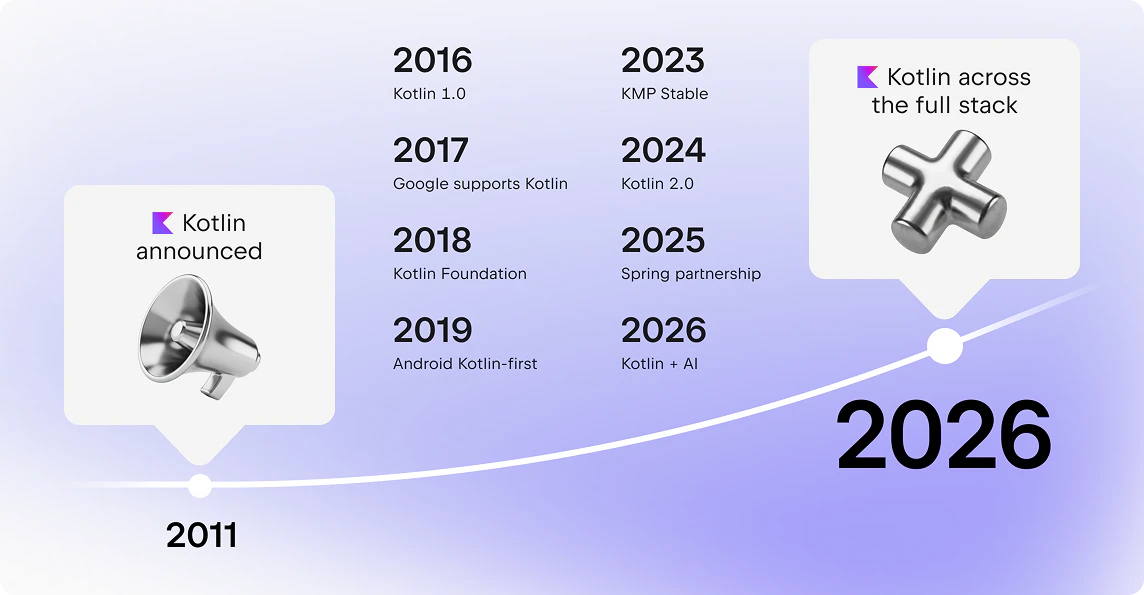
Kotlin has grown into a mature, multi-domain ecosystem. It is the default language for Android, a mainstream JVM backend choice, a stable multiplatform technology, and a language with a production-grade AI stack.
- 2011: JetBrains announces Kotlin.
- 2016: Kotlin 1.0 ships.
- 2017: Google announces official support for Kotlin on Android.
- 2018: JetBrains and Google establish the Kotlin Foundation.
- 2019: Google makes Android development Kotlin-first.
- 2023: Kotlin Multiplatform becomes stable.
- 2024: Kotlin 2.0 ships with the K2 compiler.
- 2025: JetBrains and the Spring team announce a strategic partnership.
- 2026: The Kotlin Benchmark for AI coding agents launches, and the Kotlin standard library gets a formal security and support policy.
Source: JetBrains and Google public announcements, 2011–2026.
Go deeper: The Kotlin Adoption Curve
Yes. Kotlin is a 15-year-old language that 80% of its developers run in production, used across software-intensive and regulated industries such as banking and payments (ING, Worldline), with formal long-term commitments behind it.
- About a quarter of Kotlin developers work in companies with 500+ employees.
- Kotlin held the #14 position in RedMonk's language rankings in both 2025 and 2026 – a stable top-15 placement.
- Enterprise readiness strengthened with the 2025 Spring partnership and the 2026 security and support policy for the Kotlin standard library.
Source: JetBrains State of Developer Ecosystem Survey 2025; JetBrains Kotlin Developer Survey 2025; JetBrains announcements, 2025–2026; RedMonk 2025–2026.
Go deeper: Enterprise and Organizational Adoption
Amazon, ING, Wolt, Kakao Pay, Sony, Duolingo, Booking.com, Mercedes-Benz.io, and Worldline are among the companies that use Kotlin in production and discuss it publicly across backend, mobile, multiplatform, and AI workloads.
- Amazon migrated a 10,000-line backend service from Java to Kotlin.
- ING runs a Kotlin payment engine serving 6M mobile users and 4.5B payments a year.
- Sony built the KMP + Compose Multiplatform companion app for its flagship headphones.
- Worldline runs an AI conversational platform with 1M+ monthly active users on Kotlin and Spring Boot.
Source: public company case studies and conference talks, 2024–2026.
Go deeper: Enterprise and Organizational Adoption
Yes. The talent pool spans 8.1 million developers with Kotlin experience (2025), and about half of active Kotlin developers have three or more years of experience with the language. Hiring can also draw on the much larger Java pool: 71% of Kotlin developers previously used Java.
Source: JetBrains Kotlin Developer Survey 2025; JetBrains State of Developer Ecosystem Survey 2025.
Go deeper: Talent Pool and Workforce Readiness
Yes. Kotlin Multiplatform (KMP) has been stable since 2023, Compose Multiplatform for iOS has been stable since 2025, and Google officially endorses KMP for sharing business logic between Android and iOS. Organizations report concrete business outcomes:
- KMP teams build 40–80% of their mobile codebase once and share it across platforms.
- Teams report 15–30% faster release cycles than with separate native codebases.
- Public KMP case studies report ROI within 3–6 months of adoption.
- About 60% of KMP projects share all or almost all of their business logic.
- The ecosystem includes more than 4,000 community KMP libraries.
Source: JetBrains and Google announcements, 2023–2025; JetBrains Kotlin Multiplatform Survey 2024–2025; public KMP case studies.
Go deeper: Kotlin Multiplatform – a Strategic Platform Choice
KMP's share among developers using cross-platform frameworks more than doubled in one year, from 7% (2024) to 18% (2025), and it is gaining ground in the App Store top 10,000 faster than Flutter and React Native.
- KMP's footprint among the top 10,000 iOS apps nearly tripled, from under 1% (early 2024) to almost 3% (mid-2026), outpacing Flutter and React Native.
- By mid-2026, KMP apps in the top 10,000 matched Flutter apps in total App Store revenue, despite being far outnumbered.
- Adopters include Sony, Duolingo, and Booking.com, with hundreds of millions of end users interacting with KMP-powered apps daily.
Source: Appfigures Intelligence, 2024–2026; JetBrains State of Developer Ecosystem Survey 2024–2025; public KMP case studies.
Go deeper: Kotlin Multiplatform – a Strategic Platform Choice
Yes, backend is one of Kotlin's largest domains. 53% of Kotlin developers work on backend projects, running on the same JVM, frameworks, and infrastructure as Java.
- 61% of Kotlin backend developers use Spring / Spring Boot, and 51% use Ktor.
- 89% of the largest engineering organizations (100+ backend developers) already run some Kotlin on the backend.
Source: JetBrains State of Developer Ecosystem Survey 2025; anonymized JetBrains IDE data, 2026.
Go deeper: Backend Kotlin: Stability, Productivity, and Enterprise Readiness
Yes. Kotlin is developed by JetBrains, governed with Google through the Kotlin Foundation, and now carries the formal commitments enterprises require. Full Java interoperability also protects existing JVM investments – code, libraries, and skills stay usable.
- JetBrains and the Spring team have run a strategic partnership since 2025.
- The Kotlin standard library has had a formal security and support policy since 2026.
- Kotlin is 100% interoperable with Java: Kotlin and Java coexist in the same codebase, so there is no lock-in cliff.
Source: JetBrains announcements, 2025–2026.
Go deeper: Backend Kotlin: Stability, Productivity, and Enterprise Readiness
Java teams adopt Kotlin because it adds measurable productivity to the JVM stack they already run, without a rewrite. Kotlin compiles to the same bytecode and calls existing Java code directly, so adoption usually starts inside an existing Java system, most often during modernization work.
- Development cycles in Kotlin are 15%–20% shorter development cycles than comparable Java tasks.
- 71% of Kotlin backend developers came to Kotlin from Java.
- Kotlin adoption clusters at modernization moments and is 8× higher among projects that migrated from Spring Boot 2 to Spring Boot 3 than among projects that did not.
- The newer the JDK, the likelier the switch: projects on JDK 17 adopt Kotlin about 9× more often than projects on JDK 8, and projects on JDK 21+ about 14× more often.
Source: JetBrains Research, IDE telemetry of about 320,000 developers and 28M development cycles; JetBrains State of Developer Ecosystem Survey 2025; anonymized JetBrains IDE data, 2026.
Go deeper: Backend Kotlin: Stability, Productivity, and Enterprise Readiness
Start with one new service or module. Kotlin and Java are fully interoperable and coexist in the same codebase, so teams adopt Kotlin service by service while the JVM, Spring, build pipelines, and monitoring stay unchanged.
- 70% of new Kotlin backend adopters already had Spring in the project when they added Kotlin.
- A bounded pilot lets a team measure cycle time, build time, review time, and onboarding effort before expanding.
- The full State of Kotlin in 2026 report includes a pilot checklist: what stays the same, what changes, and what to measure.
Source: anonymized JetBrains IDE data, 2026.
Go deeper: Backend Kotlin: Stability, Productivity, and Enterprise Readiness
Yes, measurably. Development cycles in Kotlin are 15–20% shorter than in comparable Java tasks, based on JetBrains IDE telemetry covering about 320,000 developers and 28 million development cycles. The methodology is described in the full State of Kotlin in 2026 report.
Source: anonymized JetBrains IDE data, 2026.
Go deeper: Backend Kotlin: Stability, Productivity, and Enterprise Readiness
Yes. Kotlin's static typing and null safety catch a common class of AI mistakes at compile time: when a model invents an API or misuses a nullable value, the code fails to compile, and coding agents read those compiler errors to fix their own output before a human reviews the diff. Kotlin's concise syntax also means fewer tokens to generate and less code to review. In JetBrains State of Kotlin and AI Survey 2026, nearly 3 in 4 Kotlin developers said Kotlin is well suited to software development in the age of AI.
Source: JetBrains State of Kotlin and AI Survey 2026 – 623 active Kotlin users surveyed at and around KotlinConf 2026, an engaged early-adopter audience.
Go deeper: Kotlin + AI: Tested in Real Workflows
Yes. In JetBrains State of Kotlin and AI Survey 2026, 93% of Kotlin developers reported using at least one AI coding tool, and 81% said they already use AI coding agents or are likely to try them.
Source: JetBrains State of Kotlin and AI Survey 2026 – 623 active Kotlin users surveyed at and around KotlinConf 2026, an engaged early-adopter audience.
Go deeper: Kotlin + AI: Tested in Real Workflows
In JetBrains State of Kotlin and AI Survey 2026, 18% of Kotlin developers said AI-generated Kotlin code is typically correct as-is, and 63% said it needs only minor fixes. Only 0.3% ship AI-generated code without checking it.
Source: JetBrains State of Kotlin and AI Survey 2026 – 623 active Kotlin users surveyed at and around KotlinConf 2026, an engaged early-adopter audience.
Go deeper: Kotlin + AI: Tested in Real Workflows
On the Kotlin Benchmark – JetBrains' public benchmark of 105 engineering tasks drawn from open-source Kotlin repositories (July 2026) – the top agent setup resolved 90 of 105 tasks, an 85.7% resolution rate. The dataset, test harness, and leaderboard are public at kotlinlang.org/benchmark, so teams can compare agents on reproducible results instead of vendor claims.
Source: the Kotlin Benchmark, 2026.
Go deeper: Kotlin + AI: Tested in Real Workflows
The State of Kotlin 2026 report is based on the JetBrains State of Developer Ecosystem Survey, the Kotlin Developer Survey, the Kotlin Multiplatform Survey, a KotlinConf 2026 community survey on AI tool usage, anonymized JetBrains IDE telemetry data, and independent sources including GitHub Octoverse, Stack Overflow, and RedMonk.