Testing arbitrary code
Lincheck provides a runConcurrentTest() function to test arbitrary concurrent code.
The runConcurrentTest() function executes a block of concurrent code multiple times and uses model checking to explore its potential execution schedules.
To test concurrent code with Lincheck:
Create a test class:
class CounterTestWithInvocations { }Create a test function as a member function using
runConcurrentTest():@Test fun test() = Lincheck.runConcurrentTest(100_000) { var counter = 0 // Increments the counter concurrently val t1 = thread { counter++ } val t2 = thread { counter++ } // Waits for the threads to finish t1.join() t2.join() // Checks that both increments have been applied assertEquals(2, counter) }Run the test. If it fails, Lincheck generates a report with an execution schedule that leads to incorrect behavior.
| ------------------------------------------------------------------------------- | | Main Thread | Thread 1 | Thread 2 | | ------------------------------------------------------------------------------- | | thread(block = Lambda#2): Thread#1 | | | | thread(block = Lambda#3): Thread#2 | | | | switch (reason: waiting for Thread 1 to finish) | | | | | | run() | | | | counter ➜ 0 | | | | switch | | | run() | | | | counter ➜ 0 | | | | counter = 1 | | | | | counter = 1 | | Thread#1.join() | | | | Thread#2.join() | | | | counter.element ➜ 1 | | | | assertEquals(2, 1): threw AssertionFailedError | | | | ------------------------------------------------------------------------------- |
Example: test ConcurrentHashMap functions
Consider this test for ConcurrentHashMap functions:
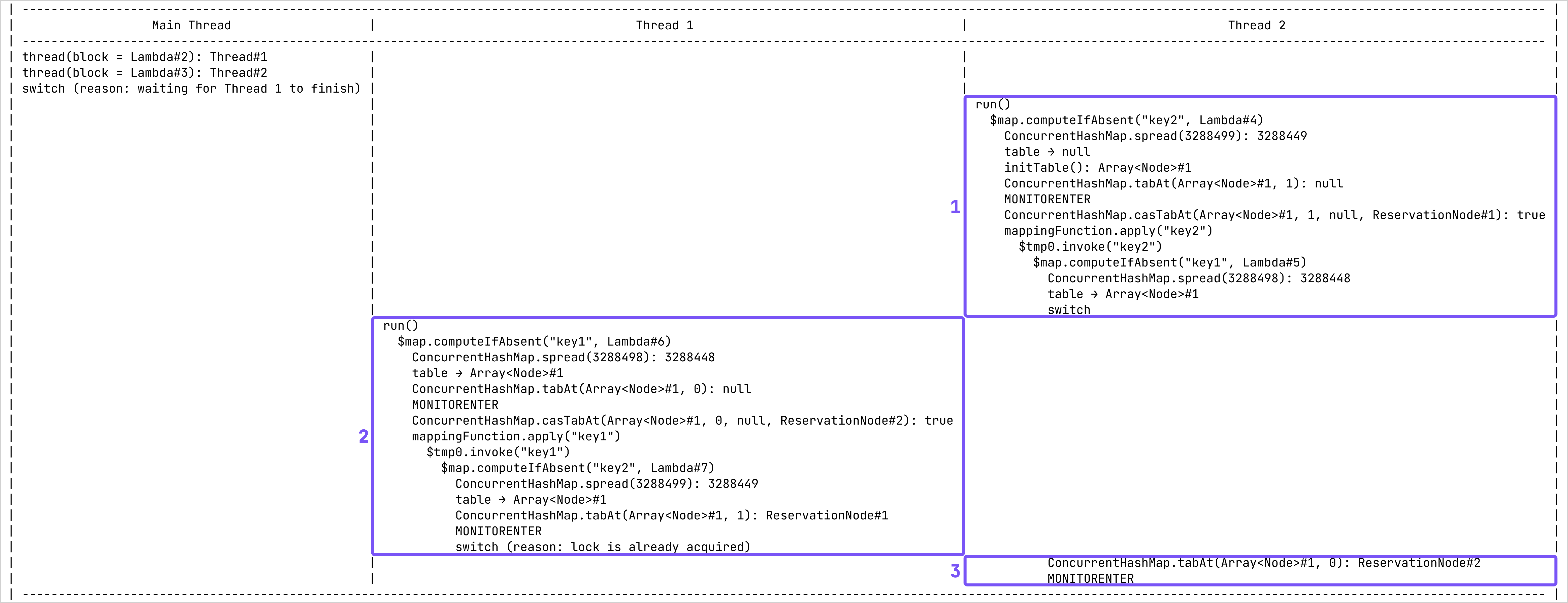
The test fails due to Lincheck finding an execution schedule that leads to a deadlock:
Thread 2 maps
key2to the bucket at index 1, places a lock on this bucket, and starts executingcomputeIfAbsent("key1"). The execution switches from Thread 2 to Thread 1 before Thread 2 mapskey1and locks the bucket withkey1.Thread 1 maps
key1to the bucket at index 0, places a lock on this bucket, and starts executingcomputeIfAbsent("key2"). Thread 1 mapskey2to the bucket at index 1 and tries to lock the bucket, but it is already locked by Thread 2. The execution switches from Thread 1 to Thread 2.Thread 2 tries to lock the bucket with
key1, but it is already locked by Thread 1.
Both threads are locked, so the execution has encountered a deadlock.
What’s next
Learn how to test data structures using Lincheck.