Model checking
To test the code using the model checking strategy, Lincheck inserts explicit thread-switch instructions at points of shared-memory access (read and write) or at synchronization points, such as lock acquisition and release, park/unpark, wait/notify, and others. This approach enables Lincheck to controllably explore the execution schedules of a program and find the ones that lead to incorrect results.
When testing concurrent code using model checking, Lincheck makes sure that the exploration of the execution schedules is:
Deterministic. Each invocation of a model checking test returns the same result if the input data has not changed.
Bounded. Each test explores only a limited number of execution schedules. The number of possible execution schedules grows exponentially with the size of the program, and always exploring all of them would significantly increase testing times. You can adjust the limit by changing the value of
invocationsPerIteration.
Compared to stress testing, model checking enables Lincheck to collect execution traces and guarantees bug reproduction for failed tests. For a more detailed comparison, see the table in the Testing strategies article.
Deterministic exploration
Model checking in Lincheck requires that, given the same input data and execution schedule, the code under test produces the same results. Deterministic execution in model checking is what enables Lincheck to collect execution traces and guarantees bug reproduction for failed tests, which means that any non-deterministic code prevents model checking from working properly.
If an execution produces a non-deterministic result, Lincheck reports an error:
Some sources of non-determinism are controlled by Lincheck, while others are either restricted for usage or might produce an unexpected test failure.
Controlled sources of non-determinism
When running a test with the model checking strategy, Lincheck controls the following sources of non-determinism:
Thread-switching. Instead of relying on the JVM for thread-switching, Lincheck inserts explicit thread-switch instructions at points of shared-memory access (
readandwrite) or at synchronization points, such as lock acquisition and release,park/unpark,wait/notify, and others.Random number generators. Lincheck fixes the random seed.
Identity hash codes. Lincheck fixes the identity hash codes of objects.
Time API calls. Lincheck intercepts the time API calls and returns deterministic results.
Top-level and
companion objectproperties. Lincheck resets the values of top-levelvarproperties andcompanion objectproperties (the Kotlin equivalents of global variables) between invocations in model checking tests:@TestMethodOrder(MethodOrderer.OrderAnnotation::class) class VariableResetTest { companion object { private var atomicInt = AtomicInteger(0) } @Test @Order(1) fun modelCheckingTest() = Lincheck.runConcurrentTest { val t1 = thread { atomicInt.getAndIncrement() } val t2 = thread { atomicInt.getAndIncrement() } t1.join() t2.join() check(atomicInt.get() == 2) } @Test @Order(2) fun resetAfterModelCheckingTest() { // Verify `atomicInt` has been reset to 0 after `modelCheckingTest()` check(atomicInt.get() == 0) } @Test @Order(3) fun regularIncTest() { atomicInt.getAndIncrement() check(atomicInt.get() == 1) } @Test @Order(4) fun valuePersistsAfterRegularIncTest() { // Verify `atomicInt` still holds 1 after `regularIncTest()` check(atomicInt.get() == 1) } }
Uncontrolled sources of non-determinism
Lincheck controls some sources of non-determinism, but not all. Using non-deterministic code in a way that Lincheck cannot control either prevents you from using Lincheck with this particular part of code or requires workarounds.
Each uncontrolled source of non-determinism is explained in detail in a dedicated section:
Bounded exploration
When testing concurrent code, Lincheck runs each execution scenario multiple times – a different execution schedule of a program is explored in each scenario invocation. Because the number of possible execution schedules grows exponentially with the size of the program, the number of invocations for a single execution scenario test is limited to reduce the testing times. If the number of the invocations required to explore all execution schedules exceeds the specified limit, Lincheck stops the exploration.
When Lincheck is unable to analyze all execution schedules, it tries to evenly analyze logically different ones:
Lincheck first explores all schedules with a single preemptive thread switch, then all schedules with two, and so on.
When choosing the next schedule to explore, Lincheck prioritizes schedules with thread switches in new locations.
Example: schedules with one thread switch
See how Lincheck models execution schedules with a single preemptive thread switch in a two-thread scenario:
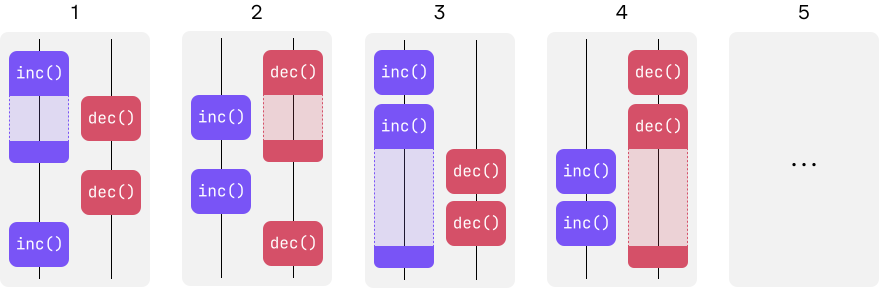
Because Lincheck starts by modeling a schedule with a thread switch in the first thread, the next modeled schedule is more likely to have a thread switch in the second thread. This continues until Lincheck either reaches the limit of explored schedules or exhausts all possible schedules.
Known limitations and workarounds
The model checking strategy has the following known limitations.
Relaxed Java memory model
Model checking requires Lincheck to assume a sequentially consistent memory model of the execution.
The relaxed memory model used in Java can introduce bugs related to instruction reordering, memory cache behavior, and other similar effects. With model checking, Lincheck cannot simulate such effects and catch bugs related to them.
Most concurrency bugs can be found even under the assumption of a sequentially consistent memory model. However, Lincheck can miss some bugs caused by low-level effects. For example, a missing @Volatile modifier might produce a bug caused by store buffer or a compiler reordering, which cannot be caught by Lincheck’s model checker:
Workaround
If you want to test concurrent code without the assumption of a sequentially consistent memory model, Lincheck provides a stress testing strategy for concurrent data structures.
Threads created outside the scenario
Lincheck can only track the threads created inside a concurrent scenario. It can miss bugs occurring in externally created threads, such as when using the default dispatcher with coroutines or the common thread pool with Java's ForkJoinPool.
Workaround
Use a fixed thread pool:
As a local coroutines dispatcher
Instead of the common thread pool used by
ForkJoinPool
This guarantees that Lincheck can track the lifecycle and activity of threads in a concurrent scenario:
Thread-local variables
Lincheck does not reset thread-local variables during multiple invocations of the same scenario (unlike it does with top-level var properties and companion object properties). This leads to inconsistencies between the runs of the same test.
Example:
This test fails with an error because the value of the counter accumulates across scenario invocations:
Workaround
Create thread-local variables manually by storing values in a ConcurrentHashMap with thread IDs as keys:
Because threadLocalCounters is a top-level var property, Lincheck resets it between invocations, avoiding the accumulation problem.
Weak references
Lincheck does not control when a garbage collector removes objects that are only referenced by weak references. Calling get() on such objects produces non-deterministic results. The test might pass successfully despite the use of weak references, but if Lincheck encounters an inconsistency between the runs of the same test, it raises a non-determinism error.
Time API calls
Lincheck simulates calls of java.lang.System.nanoTime() and java.lang.System.currentTimeMillis() by always returning a predefined constant to prevent inconsistencies between the runs of the same test.
This approach might not correctly simulate timeouts, elapsed-time comparisons, rate-limiting, or other logic that depends on elapsed time.
I/O API calls
Lincheck does not support calls to I/O APIs, including operations on files and sockets, to prevent inconsistencies between the runs of the same test.
Calling I/O APIs leads to java.lang.IllegalStateException:
Virtual threads
Support for virtual threads has not been verified and is not guaranteed. Consider using platform threads for scenarios requiring model checking until support is verified.
See also
Test any concurrent code with model checking
Use model checking to test a concurrent data structure