



fun main() {
    val name = "stranger"        // Declare your first variable
    println("Hi, $name!")        // ...and use it!
    print("Current count:")
    for (i in 0..10) {           // Loop over a range from 0 to 10
        print(" $i")
    }
}
Latest news
September 7, 2026
Kotlin 2.4.20 Released
The Kotlin 2.4.20 release is out! Here are the main highlights: For the complete list of changes, see What’s new in Kotlin 2.4.20 or the release notes on GitHub. How to install Kotlin 2.4.20 The latest version of Kotlin is included in the latest versions of IntelliJ IDEA and Android Studio. To update to the […]
September 3, 2026
Kotlin Toolchain 0.12: Multiplatform Library Publishing, Wasm Apps, and More
Kotlin Toolchain 0.12.0 is out. This release brings some long-awaited features: multiplatform libraries publication, a preview of Wasm application support, Compose Hot Reload from the command line, and more. Read on for the details, and check the release notes for the full list of changes and bug fixes. Additionally, klibs.io now uses the Kotlin Toolchain […]

August 26, 2026
Compose Multiplatform 1.12.0 Released
Compose Multiplatform 1.12.0 is out! This version brings new tooling for AI assistants, improvements to web resource management, and finer control over desktop window states. Here are the highlights of this release: For a complete overview of the changes, check out What’s new in Compose Multiplatform 1.12.0 or the release notes on GitHub. Get Started […]
August 19, 2026
Signatures, be true: domain errors and functional handling in Kotlin
Here’s a function that signs a document: In Kotlin, Unit means the function completes without returning a meaningful value – roughly equivalent to void in Java. Got it? Now, tell me what could go wrong. You can’t. Yet, the code might be invalid. The signing window might have closed. The database might be down. The […]
Kotlin in action







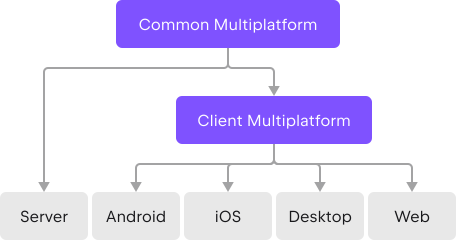
Share code on your terms and for different platforms
Big, friendly and helpful community


Kotlin Foundation